
From 5 Hours to 45 Minutes: How I Automated D&D Session Prep
I used to spend Sunday afternoons buried in notebooks and browser tabs, frantically scribbling encounter notes and improvising NPC voices while my coffee went cold. Five hours of prep for a four-hour session. The math never added up, but the burnout was real.
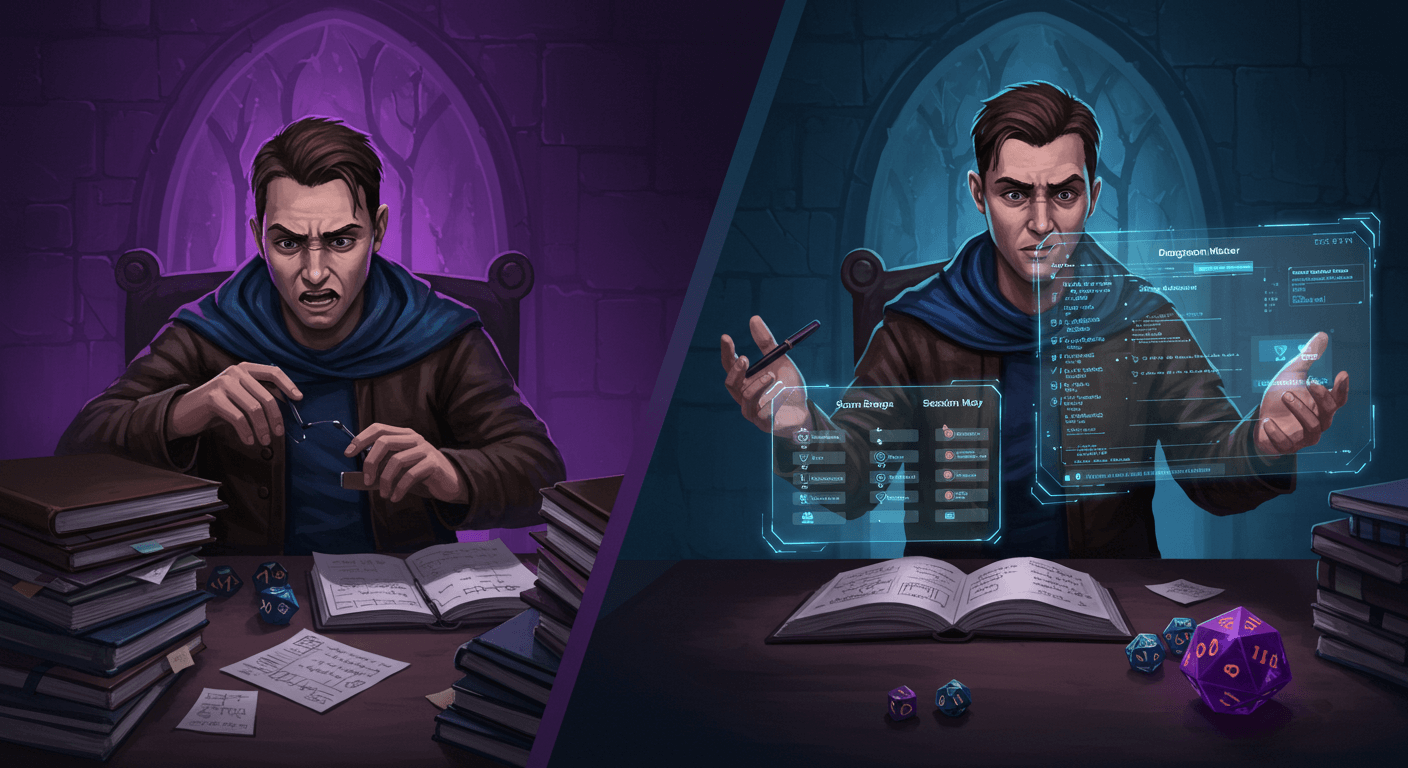
Last Tuesday, I prepped our entire Curse of Strahd session in 45 minutes. Same quality. Better organization. Zero panic. Here's how I broke free from the prep time prison that's slowly killing DM enthusiasm across the hobby.
The Old Way: Sunday Scream Sessions
Picture this: It's 2:00 PM Sunday. Session starts at 7:00 PM. I'm sitting at my kitchen table surrounded by:
Three open laptops (campaign notes, Roll20, D&D Beyond)
A stack of notebooks from previous sessions
Printed NPC stat blocks I'll never actually reference
A growing sense of dread
My "efficient" prep workflow looked like this:
Step 1: Archaeological Dig (60 minutes)
Excavating last session's notes from my scattered digital graveyard. Where did they leave off? What was that NPC's name? Did I ever write down the mayor's voice quirks?
Step 2: Mental Gymnastics (90 minutes)
Trying to predict player choices. "They might go to the tavern OR the cathedral OR completely ignore both and burn down the orphanage." Planning for seventeen different scenarios.
Step 3: Stat Block Shuffle (60 minutes)
Building encounters from scratch, adjusting CR, printing backup options. Because what if they avoid the main combat? What if they steamroll it?
Step 4: NPC Panic (90 minutes)
Realizing I need seven unique voices, backstories, and motivations. frantically sketching personality notes on napkins.
Step 5: Last-Minute Terror (30 minutes)
Double-checking everything while players text "still on for tonight?" Total time: 5+ hours. Energy level: depleted. Confidence: fake it till you make it.
The Breaking Point: February 14th, 2025
Valentine's Day. My partner asked if I wanted to go out for dinner before D&D. I looked at my prep pile and said no. I had to prep.
She looked at me — really looked — and said, "You spend more time preparing to have fun than actually having fun."
That hit harder than a disintegration ray.
That night, I ran the session anyway. It was fine. The players had a blast. But I kept thinking: What if there was a better way?
Enter the Machines: My AI-Powered Revolution
I'm a software engineer. I automate boring stuff for a living. Why wasn't I automating my own hobby?
I started small. Instead of manually writing session recaps, I fed our Discord voice recordings to a transcription service. Instead of frantically googling "medieval tavern names," I asked Claude to generate ten options in thirty seconds.
But the real breakthrough came when I discovered campaign intelligence tools that actually understood my specific campaign context.
Here's my current 45-minute prep workflow:
New Workflow: The 45-Minute Sprint
Minutes 1-10: Campaign Catch-Up
My AI assistant reads the last three session transcripts and generates a two-page "where we left off" summary. Player decisions, unresolved plot threads, NPC relationships — all synthesized from actual gameplay, not my foggy memory.
No more archaeological digs. The machine remembers everything.
Minutes 11-20: Intelligent Scene Planning
Instead of planning for seventeen scenarios, I describe the current situation to my AI tool: "Players are investigating strange disappearances in Vallaki. They suspect either the church or the tavern keeper."
It generates three flexible scenes with multiple entry/exit points. Not rigid railroads — adaptive frameworks that respond to player choices.
Minutes 21-30: Contextual NPC Generation
The AI knows my campaign world. When it generates an NPC, it understands:
The political situation in Vallaki
My existing NPC relationships
The party's current reputation
Barovia's gothic horror tone
Instead of generic "gruff blacksmith," I get "Mikhail, the nervous blacksmith who's been hearing whispers from his dead wife since the players arrived. He wants to help but fears Strahd's attention."
Minutes 31-40: Combat Encounters That Fit
No more stat block shuffle. I describe the narrative situation ("Strahd tests the party with undead in the church") and get a balanced encounter that considers:
Current party level and resources
Story relevance
Environmental factors
Multiple victory/escape conditions
Minutes 41-45: Final Review
A quick scan of generated content, adding personal touches and contingency plans.
Done. Confident. Ready to be surprised by my players.
The Tools That Changed Everything
I'm not going to pretend you need some massive software suite. The secret is finding tools that understand your specific campaign rather than generic D&D content.
For Campaign Continuity:
I use StormScape to automatically record and transcribe our Discord sessions. Every conversation, every decision, every throwaway joke becomes searchable campaign history. No more "wait, what was that guy's name?"
For Intelligent Content Generation:
Modern AI can generate NPCs, encounters, and scenes that fit your world's tone and context — if you feed it the right information. The difference between "generic fantasy tavern" and "a tavern in Vallaki where the locals whisper about missing children" is context.
For Encounter Balance:
Tools that understand party composition and resource management can build encounters that challenge without overwhelming. No more TPK anxiety.
What I Gained (Beyond Time)
Cutting prep time from 5 hours to 45 minutes gave me more than Sunday afternoons back. It gave me confidence.
I'm no longer frantically improvising when players go off-script. My AI tools help me adapt in real-time, generating content that fits the world we've built together.
More importantly, I'm actually excited about sessions again. Prep feels like creative collaboration instead of homework.
The Automation Mindset: What to Keep, What to Cut
Here's what I learned about smart automation:
Automate the Boring Stuff:
Session note transcription
Basic NPC stat generation
Encounter CR calculations
Campaign timeline tracking
Keep the Creative Stuff:
Player-specific story moments
Emotional beats and reveals
Your unique DM voice and style
Spontaneous player interactions
The goal isn't to replace creativity — it's to free up creative energy for the moments that matter.
Your 45-Minute Future
You don't need to be a software engineer to automate your prep. You just need to stop accepting that DM burnout is inevitable.
Start with one workflow improvement:
Record and auto-transcribe one session
Use AI to generate three NPCs with actual personality
Let a tool handle your next encounter balance calculation
Build from there. Your Sunday afternoons are worth saving.
The Human Element
Here's the thing about AI-assisted DMing: it makes you a better storyteller, not a replacement one. When I'm not stressed about prep, I'm more present during the session. I listen better. I respond to player cues instead of desperately checking my notes.
My players don't know I prep in 45 minutes. They just know the sessions feel more responsive and alive.
And that's the real magic: using technology to enhance human connection around a table.
---
Want to try automated session prep for your campaign? StormScape offers free campaign intelligence reports for your Discord-based sessions. No more Sunday prep panic required.
How long does your current session prep take? Share your horror stories (and solutions) in the comments below.

Storm Burpee
Founder of StormScape
Storm is the founder and chief architect of StormScape, where a decade of dungeon mastering collides with cutting-edge AI technology. As an active DM running multiple weekly campaigns—including an intricate homebrew world in "The Shattered Crown" and a heavily modified Curse of Strahd—Storm intimately understands the overwhelming prep work that burns out even passionate DMs. This frustration led to building StormScape: the AI-powered campaign management platform that actually understands how D&D works. With a background in conversational AI and automation systems (having built enterprise-grade voice agents and lead generation platforms), Storm brings a unique perspective to the TTRPG tool space. They believe technology should enhance storytelling, not replace it—tools should be invisible during play but invaluable during prep. When not merging code commits or crafting plot twists, Storm can be found obsessing over Magic: The Gathering sealed pools, managing multiple fantasy football teams, or exploring new ways to torment—err, delight—their players.
Found this helpful? Share it with your party!