

# The D&D Session Recap Template My Players Actually Read
A lot of DMs think the recap problem is a discipline problem.
Your players forgot the NPC name. They forgot the deal they made three sessions ago. They forgot why the creepy silver key mattered. So the easy conclusion is, well, they just are not paying attention.
I do not think that is usually true.
I think most tables have a systems problem, not a caring problem.
Your players have jobs, partners, kids, group chats, errands, other hobbies, and a full week of life between sessions. Then game night rolls around and you ask them to instantly reload a living fantasy world with twelve active threads, seven NPCs, one cursed relic, two unresolved emotional beats, and that one lie they told a baron six sessions ago.
Of course they forget stuff.
Honestly, sometimes I forgot stuff, and I was the one running the bloody campaign.
That is why a good D&D session recap matters so much. Not a giant wall of prose nobody reads. Not a vague, "you fought some wolves and learned a secret" summary that helps nobody. A recap that actually reloads the campaign into everyone's head in under three minutes.
This is the D&D session recap template I wish I had years earlier, plus the rules that make people actually read it.
And at the end, I will show you how I automate the whole thing now, because manually maintaining campaign memory forever is exactly how DMs burn out.
Why most D&D session recaps fail
After a lot of campaigns, and a lot of watching what players do and do not retain, I think most session recaps fail for one of five reasons.
1. They are written like novels, not reload screens
A recap is not there to impress people with your prose. It is there to get everyone back into the right headspace fast.
If the recap takes seven minutes to read, most players will skim it. If it buries the important clue in paragraph six, they will miss it.
2. They focus on chronology instead of relevance
What happened first is not always what matters most.
Players usually need to remember:
what they were trying to do
what changed
what new threats or opportunities appeared
what names, promises, and clues still matter
where the session is about to pick up again
That is different from a perfect blow by blow transcript.
3. They make the DM do all the remembering manually
This is the big one.
The standard advice online is still some version of:
ask a player to recap
fill in the blanks
write quick notes after the session
reward players for remembering
That can help. But it still assumes somebody at the table is consistently doing reliable admin after a four hour session when everyone is tired.
That is where most recap systems die.
4. They are not searchable later
A recap is useful this week. Campaign memory is useful six weeks from now when someone says, "Hang on, have we met this priest before?"
If your recap lives in a Discord message that disappeared into history, or a random Google Doc nobody opens, it solves tonight's problem and then dies.
5. They ignore emotion
Players do not just remember facts. They remember tension, betrayal, triumph, fear, comedy, guilt, and that moment an NPC said something that landed a little too hard.
A recap that only tracks logistics misses half the reason people play tabletop RPGs in the first place.
The job of a good D&D session recap
A good recap should do five things quickly:
remind players where they were and what they wanted
surface the important names, clues, and consequences
preserve character and relationship beats
point clearly at the next session's starting tension
give the DM usable campaign memory, not just a disposable summary
That last bit matters more than people think.
The recap is not just a player handout. It is the seed of your campaign brain.
The D&D session recap template
Here is the template I recommend.
It is short on purpose.
1. One-paragraph opening recap
Start with 4 to 6 sentences max.
This is the cinematic version. The "previously on" section. It should answer:
where the party was
what they were trying to accomplish
what changed by the end
what unresolved tension is hanging in the air
Template:
Last session, the party traveled to [location] to [goal].
Along the way, they .
The biggest turn came when .
By the end of the session, .
They now face .
This part should feel like a clean mental reload, not a lore dump.
2. Key events in bullet points
After the paragraph, switch to bullets.
This is where people actually retain details.
Template:
Major events: 3 to 6 bullets covering the session's biggest beats
Important discoveries: clues, secrets, map info, item reveals, or lore that matters later
NPC developments: new NPCs introduced, changed loyalties, promises made, tensions escalated
Quest progress: what moved forward, what stalled, what changed direction
Keep each bullet tight. If a bullet is becoming a paragraph, it is doing too much.
3. Names and threads to remember
This is the section most recaps skip, and it is usually the section players need most.
Template:
People to remember:
-Places to remember: [location] -
Open threads: [question, danger, promise, debt, clue, missing person, ticking clock]
If your campaign is even a little political, investigative, or relationship-heavy, this section saves your arse constantly.
4. Character moments
This is how the recap stops feeling sterile.
List 2 to 4 moments that mattered emotionally or personally.
Template:
Character beats: moments of conflict, growth, fear, sacrifice, romance, guilt, or revelation
Relationship shifts: trust gained, trust broken, rivalries sharpened, loyalties tested
You are not just preserving plot. You are preserving the shape of the story.
5. Start-next-session hook
End with one line about where next session begins.
Template:
Next session starts with:
This gives everyone a clean runway back into play.
A copy-paste D&D session recap template
If you just want the practical version, use this.
Session recap
Where we left off:
What the party was trying to do:
What changed:
Immediate problem now:
Key events
Important discoveries
People, places, and threads to remember
People:
Places:
Open threads:
Character moments
Next session starts with
If your group likes a more in-world voice, you can wrap this with flavour. But keep the bones intact.
What players actually care about in a recap
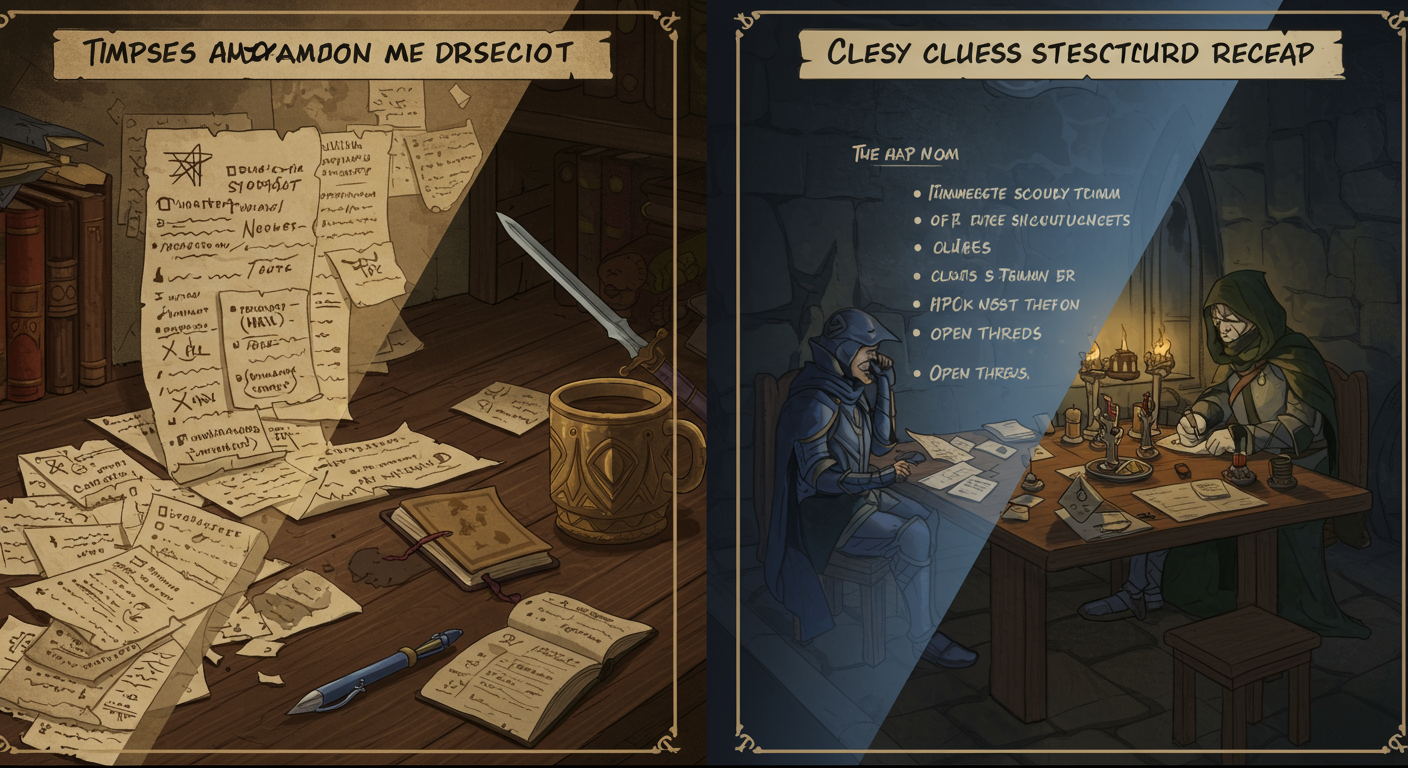
This is the bit I wish more DM advice would say plainly.
Most players do not want a historian's record.
They want answers to questions like:
Who are we dealing with again?
Why did we hate this guy?
What were we trying to do before initiative happened?
Which clue mattered and which one was flavour?
Are we in danger right now, or just between scenes?
What did my character feel about that moment?
That is why the best recaps are selective.
A Reddit thread about session synopses had the same pattern you see everywhere: DMs either ask players to do a recap and patch the gaps, or the DM reads a short summary because people have normal lives and memory is patchy between sessions. Another thread about players forgetting last session had the same underlying truth. Forgetting usually does not mean the table is disengaged. It means the campaign is competing with the rest of adulthood.
That is exactly why your recap format matters.
Manual recaps work, until they don't
I still think manual recaps can be great in the right group.
If one of your players loves doing an in-character diary entry, amazing. If your table genuinely enjoys a player-led "previously on" moment, keep it. If you only run short arcs and your note load is light, you might not need anything fancy.
But long campaigns eventually expose the weakness.
Because what starts as:
one quick recap note
one Google Doc
one Discord post
one session summary channel
slowly becomes:
fifty recap posts
NPC details scattered across tools
clues buried in old messages
one player remembering a thing differently
you spending Sunday trying to reconstruct what is canon
That is when recap stops being a nice ritual and starts becoming infrastructure.
The shift from recap to campaign memory
This is where I think most tools still stop too early.
World Anvil, Kanka, and LegendKeeper are useful when you want somewhere for information to live. They help you organise. They help you document. That matters.
But the pain point I keep seeing from real DMs is not just storage.
It is transformation.
The hard part is not asking, "Where can I put notes?"
The hard part is asking:
how do I turn a messy four hour session into clean memory
how do I pull out the names, clues, relationships, and quest changes automatically
how do I avoid spending my recovery day doing admin
how do I make sure next week's prep starts from what actually happened, not what I vaguely remember happened
That is the gap between note-taking and campaign intelligence.
How I automate D&D session recaps now
This is the point where StormScape became less of a shiny AI toy and more of a sanity-preserving system for me.
Instead of trying to write a perfect recap from memory after the session, I record the session, transcribe it, and let StormScape turn that raw material into structured campaign memory.
That means I can get:
a readable player-facing recap
searchable session notes
extracted NPCs, locations, and plot threads
continuity across sessions
prep context for the next game without manually reconstructing everything
The part I care about most is not even the summary itself.
It is that the session does not vanish the moment it ends.
If I want to know when an NPC first lied to the party, when a relationship started to crack, or what clue the players ignored three sessions ago, I can actually find it.
That is the difference between "we have notes somewhere" and "the campaign remembers itself."
If you are curious about the capture side, I already wrote about how to automatically record and transcribe your D&D sessions. If your bigger problem is prep time, this is how I cut session prep from 5 hours to 45 minutes.
The 2 AM test
I keep using this test because I think it is the only one that matters.
If a burned-out DM finds your advice at 2 AM, after work, after dishes, after trying to remember what voice they used for a vampire accountant six sessions ago, does it make them feel seen?
A good session recap system should.
It should say:
you are not lazy
your players are not bad people
long campaigns are cognitively heavy
you do not need a better guilt system
you need lighter admin and better memory support
That is why I do not think the answer is "just take better notes."
The answer is building a system that respects the reality of how people actually run campaigns.
My recommendation
If your current recap process is fragile, start simple.
Use the template above for your next session. Keep it short. Add the "names and threads to remember" section. End with a one-line hook for next session.
That alone will make your recaps better than most.
But if you are running a long campaign, especially online, I would seriously look at moving beyond recap documents entirely and into a system that records, transcribes, summarises, and preserves campaign memory for you.
Because the DM work that kills momentum is rarely the dramatic stuff.
It is the invisible admin.
And the more of that you can hand off, the more energy you keep for the part that actually matters, which is making your table feel something.

Storm Burpee
Founder of StormScape
Storm is the founder and chief architect of StormScape, where a decade of dungeon mastering collides with cutting-edge AI technology. As an active DM running multiple weekly campaigns—including an intricate homebrew world in "The Shattered Crown" and a heavily modified Curse of Strahd—Storm intimately understands the overwhelming prep work that burns out even passionate DMs. This frustration led to building StormScape: the AI-powered campaign management platform that actually understands how D&D works. With a background in conversational AI and automation systems (having built enterprise-grade voice agents and lead generation platforms), Storm brings a unique perspective to the TTRPG tool space. They believe technology should enhance storytelling, not replace it—tools should be invisible during play but invaluable during prep. When not merging code commits or crafting plot twists, Storm can be found obsessing over Magic: The Gathering sealed pools, managing multiple fantasy football teams, or exploring new ways to torment—err, delight—their players.
Found this helpful? Share it with your party!

