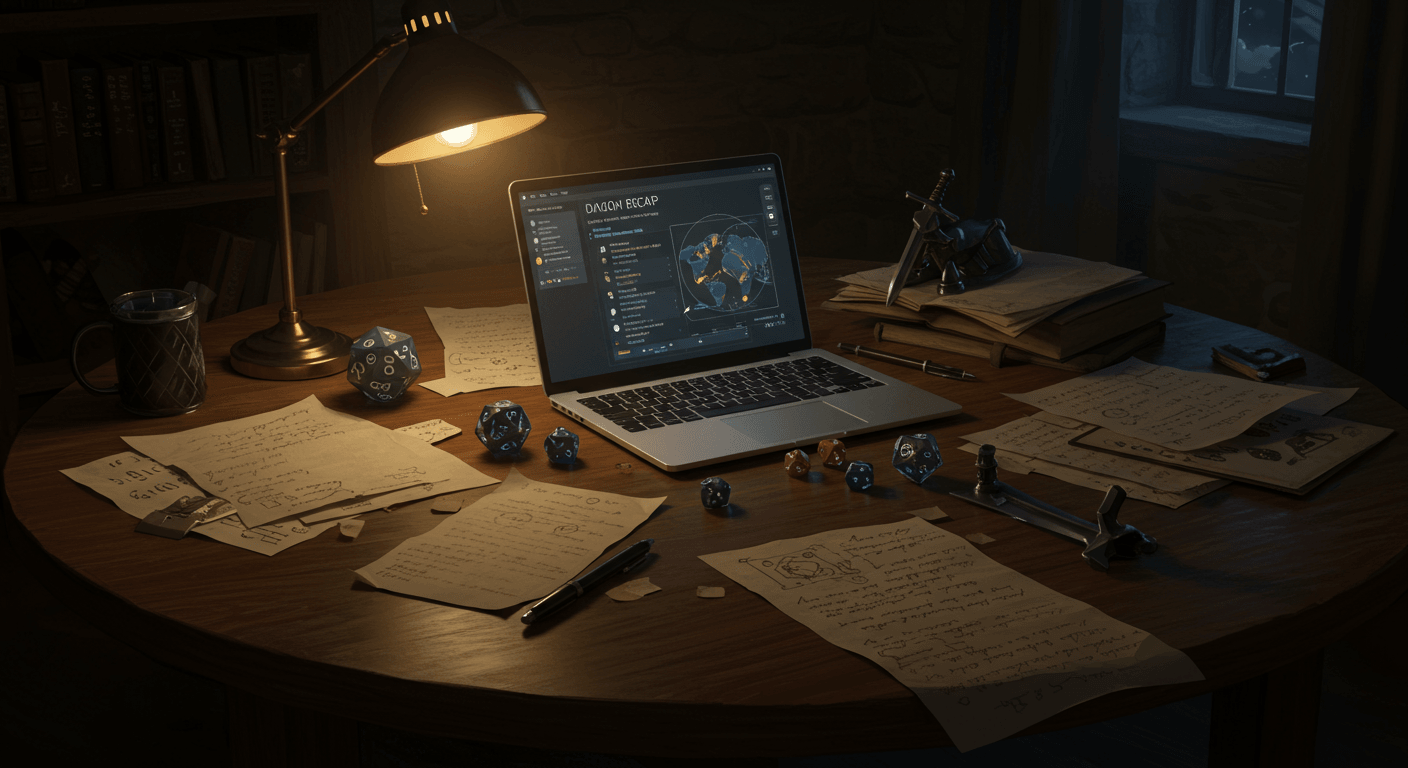


The Night I Almost Sent "Campaign's Over"
February 3rd, 2025. 11:47 PM.
I had a message typed in our Discord:
"Hey everyone, I need to be honest. I can't do this anymore. The campaign is—"
My cursor hovered over send.
Three years. 127 sessions. Five players who'd become close friends. An epic story we'd built together through pandemic lockdowns, job changes, and life upheavals.
And I was about to throw it all away because I couldn't face another Sunday of pretending to be 47 different NPCs while juggling 12 plot threads I'd lost track of months ago.
I deleted the message. Opened my campaign notes. Stared at 400+ pages of worldbuilding that felt like someone else had written it. Closed my laptop.
Then I did something I'd never done in 15 years of DMing: I cried.
The Slow Death of Joy: How Burnout Actually Happens
Burnout doesn't arrive with fanfare. It creeps in like fog, so gradual you don't notice until you're completely lost.
Stage 1: The Enthusiasm Trap (Months 1-6)
What It Looked Like:
20+ hours weekly on worldbuilding
Creating custom art for every NPC
Writing session recaps like novels
Saying yes to every player request
Running extra "side sessions"
The Warning Signs I Ignored:
Staying up until 3 AM finishing prep
Canceling social plans to work on campaign
Getting irritated when players didn't notice details
Feeling like sessions were never "good enough"
Stage 2: The Obligation Phase (Months 7-18)
The Shift:
DMing became a job, not a joy
Dreaded player questions between sessions
Procrastinated prep until last minute
Recycled content hoping nobody noticed
Fantasized about rocks falling, everyone dies
What My Players Saw:
Sessions still happened
I still smiled and laughed
NPCs still had voices
Story still progressed
What They Didn't See:
Anxiety attacks before sessions
Complete creative block
Resentment building
The joy completely gone
Stage 3: The Breaking Point (Months 19-24)
The Collapse:
Canceled sessions increased
"Sick" more often (mentally true)
NPCs became cardboard
Stopped taking notes
Actively wanted campaign to end
Considered ghosting entirely
Stage 4: The Crisis (Month 25)
That night in February, staring at the unsent message, I realized three things:
I didn't hate D&D—I hated what DMing had become
My players deserved better than a burned-out DM
Something had to fundamentally change or end
The Campaign Health Check That Changed Everything
Instead of quitting, I created a diagnostic. Answer honestly:
Scoring:
0-1 "Yes": Normal DM stress
2-3 "Yes": Warning signs—need changes
4-5 "Yes": Critical burnout—immediate action required
I scored 5/5.
The Recovery: A Systematic Approach to Saving Your Campaign
Week 1-2: The Emergency Pause
What I Did: Sent this message:
"Hey everyone, I need a two-week break to recharge and reorganize our campaign. You're all amazing, and I want to give you the game you deserve. Let's use this time for everyone to update character backstories and goals."
Why It Worked:
No guilt or over-explanation
Gave players something to do
Set a return date (crucial)
Framed as improvement, not failure
Week 3-4: The Brutal Audit
I analyzed everything with one question: "Does this spark joy or dread?"
KEEP (Joy):
Core player characters and their arcs
Three main plot threads
Ten essential NPCs
The world's basic geography
Our established house rules
CUT (Dread):
47 subplot threads going nowhere
200+ NPCs who didn't matter
Elaborate timeline tracking
Complex faction politics nobody cared about
My 400-page worldbuilding document
The 80/20 Rule: 80% of campaign fun came from 20% of my prep.
Week 5-6: The Great Simplification
Plot Threads: From 12 to 3
Before:
Duke's corruption scandal
Thieves guild war
Dragon cult uprising
Planar invasion threat
Ancient artifact hunt
Royal succession crisis
Religious schism
Trade route disputes
Mysterious plague
Underground rebellion
Fey court politics
Time loop mystery
After:
Dragon cult (main threat)
Duke's corruption (connected to cult)
Player backstories (woven into cult plot)
Everything else? "Resolved offscreen" or "mysteriously disappeared."
NPCs: The 10-Character Limit
New rule: Maximum 10 active NPCs at any time.
3 allied NPCs (quest givers, allies)
3 antagonist NPCs (villains, rivals)
4 supporting NPCs (merchants, contacts, flavor)
Everyone else became "background citizens."
Prep Time: The 1-Hour Cap
Old prep: 3-5 hours of anxiety-fueled perfection New prep: 1 hour maximum, timer enforced
Week 7-8: The AI Revolution
This is when I started building what became StormScape.
What I Automated:
NPC generation (30 seconds vs 30 minutes)
Session recaps (AI-generated from notes)
Random encounters (one click generation)
Loot generation (instant and balanced)
Initiative tracking (automatic)
The Time Saved: 2+ hours per session
Week 9-10: The Player Partnership
The Conversation:
"I've been struggling with burnout. I want to continue, but I need help. Here's what would help:"
Player Responsibilities Now:
Session recaps (rotating duty)
Initiative tracking (designated player)
Rules lookup (rules lawyer promoted)
Note-taking (party scribe)
NPC voice suggestions (collaborative)
The Response: "Why didn't you tell us sooner? We thought you enjoyed doing everything!"
Week 11-12: The Format Revolution
Old Format:
4-5 hour marathon sessions
Every week without fail
Full party required
Epic scope every session
New Format:
2.5-3 hour focused sessions
Every other week
Can run with 3/5 players
Some sessions just roleplay
Some sessions just combat
Some sessions just exploration
The Rebirth: Rediscovering Why We Play
Month 1 After Changes: The Awkward Phase
First session back was weird:
I used AI-generated NPCs (felt like cheating)
Players ran combat (felt like losing control)
Session was only 2.5 hours (felt too short)
Simplified plot (felt like dumbing down)
But something magical happened: I had fun.
Month 2: The Flow Returns
Signs of Recovery:
Looked forward to sessions
Ideas came naturally again
Laughed genuinely during play
Stayed present instead of planning
Players noticed energy change
Player Feedback: "These last few sessions have been the best in months. You seem like yourself again."
They were right.
Month 3: Better Than Ever
The campaign didn't just survive—it thrived:
Tighter Story: Three plots meant deeper exploration
Memorable NPCs: Ten characters with depth beat 200 cardboard cutouts
Player Agency: They drove more without me controlling everything
Genuine Moments: Without perfectionism, authentic magic happened
Sustainable Pace: Biweekly meant everyone stayed hungry for more
The Toolkit: Practical Burnout Prevention
The Energy Audit Spreadsheet
Track after each session:
Energy before (1-10)
Energy after (1-10)
Prep time spent
Enjoyment level
What sparked joy
What caused dread
Red Flag: If post-session energy is consistently lower than pre-session.
The Ruthless Elimination List
Every month, ask:
What can I cut that players won't miss?
What prep gives minimal return?
Which NPCs can disappear?
Which rules can we ignore?
What can players handle?
Remember: Every elimination creates space for joy.
The Sacred Boundaries
My Non-Negotiables Now:
No prep after 10 PM
No sessions when exhausted
No apologizing for breaks
No guilt about using AI
No shame about simplification
No DMing as obligation
The Emergency Protocols
Warning Signs Protocol:
Dreading next session → Take one week off
Prep taking 3+ hours → Cut scope in half
Resentment building → Player conversation needed
Creative block → Use generators/AI
Want campaign to end → Two week break minimum
Nuclear Option Protocol: If burnout becomes critical:
Immediate 1-month hiatus
Run one-shots only for 2 months
Return with radically simplified campaign
Or transition to new DM with blessing
The Honest Truths About DM Burnout
Truth 1: It's Not About Being Good Enough
Burnout hits the BEST DMs hardest. The ones who care most, prep most, create most. Mediocre DMs don't burn out—they're not invested enough.
Truth 2: Your Players Can't See Your Struggle
Players judge sessions by their fun, not your effort. They'd rather have a simple fun session than a complex miserable one.
Truth 3: Perfection Is the Enemy
The perfect campaign that burns you out in 6 months loses to the good-enough campaign that runs for 6 years.
Truth 4: AI Isn't Cheating
Using tools to reduce prep isn't lazy—it's smart. You use calculators for math. Use AI for prep.
Truth 5: Quitting Isn't Failure
Sometimes the healthiest choice is ending a campaign. Better to end with dignity than limp to resentful conclusion.
The Phoenix Campaign: What Rose From the Ashes
Today, 9 months after almost quitting:
Campaign Status: Approaching epic conclusion
Player Engagement: Highest ever
Prep Time: 45 minutes average
Personal Energy: Sustainable and joy-filled
Session Quality: Better than the "perfect" days
DM Satisfaction: Remember why I love this
The Irony: By caring less about perfection, I became a better DM.
Your Campaign Deserves a Healthy DM
If you're reading this at midnight, stressed about tomorrow's session, exhausted but unable to stop prepping, wondering why you don't love this anymore—
Stop.
Breathe.
You're not alone.
You're not failing.
You're human.
Your campaign needs you healthy more than it needs you perfect. Your players want you present more than they want you prepared. Your story needs you sustainable more than it needs you sacrificial.
The Permission You Need to Hear
From one burned-out DM to another, you have permission to:
Cancel next session if you need rest
Use AI for everything you can
Cut 90% of your worldbuilding
Say "I don't know, what do you think?"
Run simple combat
Forget NPC voices
Use pre-made content
Take a month off
Ask for help
Quit if you need to
Start over simpler
Choose joy over perfection
A Letter to Past Me (And Maybe Present You)
Storm,
That campaign you're killing yourself over? In 10 years, nobody will remember the intricate faction politics you mapped out. They'll remember laughing until they cried when the barbarian adopted 37 cats.
They won't remember the perfect battle map you spent 6 hours creating. They'll remember the tension in your voice when the dragon appeared.
They won't remember the 400-page worldbuilding document. They'll remember the moment their character's backstory suddenly mattered.
Stop building a monument to your exhaustion. Start creating moments of joy.
It gets better. But only if you let it.
- Future Storm
The Call to Action: Save Your Campaign Today
Right now, you have three choices:
Continue suffering until you quit forever
Take a break and return with the same problems
Transform your approach and rediscover joy
If you choose transformation, here's your Week 1 assignment:
Take the Campaign Health Check (honestly)
Cancel next session if you scored 3+
Send the "I need a break" message
List everything causing dread
Cut 50% of it immediately
Try one AI tool for prep
Ask players for help
Resources for Recovery
The Burnout Recovery Kit (Free Download)
Campaign Health Check worksheet
Energy tracking spreadsheet
Elimination audit template
Player help request scripts
AI prompt collection for prep
Boundary setting guide
Recovery timeline template
The Support You Need
StormScape Features for Burnout Recovery:
30-second NPC generation
Automatic session summaries
AI plot thread tracking
One-click encounter building
Player-managed wikis
Prep time tracking
Wellness monitoring
The Final Truth
Six months ago, I almost destroyed something beautiful because I confused suffering with love.
I thought loving my campaign meant sacrificing everything for it. I thought being a good DM meant perfection. I thought my players needed me to burn myself out for their fun.
I was wrong about everything.
Love means sustainability. Good means good enough. Players need you healthy.
Your campaign is not your obligation. It's your joy.
If you've lost that joy, you can find it again.
I did.
You will too.
Your turn: Where are you on the burnout spectrum? What's one thing you could eliminate from your prep that players wouldn't even notice? Share in the comments—let's normalize sustainable DMing.

Storm Burpee
Founder of StormScape
Storm is the founder and chief architect of StormScape, where a decade of dungeon mastering collides with cutting-edge AI technology. As an active DM running multiple weekly campaigns—including an intricate homebrew world in "The Shattered Crown" and a heavily modified Curse of Strahd—Storm intimately understands the overwhelming prep work that burns out even passionate DMs. This frustration led to building StormScape: the AI-powered campaign management platform that actually understands how D&D works. With a background in conversational AI and automation systems (having built enterprise-grade voice agents and lead generation platforms), Storm brings a unique perspective to the TTRPG tool space. They believe technology should enhance storytelling, not replace it—tools should be invisible during play but invaluable during prep. When not merging code commits or crafting plot twists, Storm can be found obsessing over Magic: The Gathering sealed pools, managing multiple fantasy football teams, or exploring new ways to torment—err, delight—their players.
Found this helpful? Share it with your party!